
Have Questions? Talk to Expert (Binod)
Situated beyond the mighty Annapurna and Dhaulagiri ranges, the Mustang Region of Nepal is one of the Himalayas' most extraordinary destinations. Known as the Last Forbidden Kingdom, Mustang remained isolated from the outside world for centuries, preserving a unique Tibetan-influenced culture, ancient monasteries, dramatic desert landscapes, and traditions that have changed little over time.
Today, Mustang offers travelers an unforgettable combination of adventure, culture, history, and spirituality. From the sacred pilgrimage site of Muktinath to the legendary walled city of Lo Manthang, every corner of Mustang reveals a fascinating story. Whether you are seeking a challenging trek, a scenic jeep adventure, a photography expedition, or a cultural exploration, Mustang delivers an experience unlike anywhere else in Nepal.
At Himalayan Adventure Intl Treks, we invite you to explore this remarkable region with experienced local guides who know every trail, monastery, and hidden valley. Our carefully designed Mustang trekking programs provide authentic experiences while ensuring comfort, safety, and unforgettable memories.
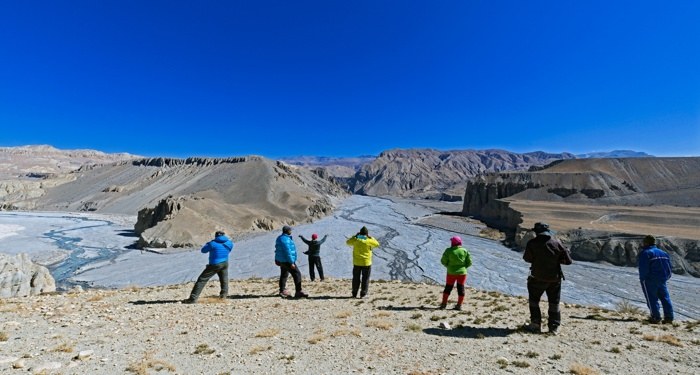
Mustang is often described as a place where time stands still. Unlike the lush green hills found in much of Nepal, Mustang lies within the Himalayan rain shadow, creating a landscape of colorful cliffs, deep canyons, wind-sculpted rock formations, and vast desert plateaus.
What makes Mustang truly special is its ability to combine spectacular scenery with living culture. Here, ancient Buddhist monasteries remain active, prayer flags flutter across mountain passes, and traditional mud-brick villages continue centuries-old ways of life.
Mustang is not simply a trekking destination—it is a cultural and spiritual journey into one of the most preserved regions of the Himalayas.
Mustang lies in north-central Nepal, bordering Tibet (China) to the north. The region is situated within Gandaki Province and stretches along the Kali Gandaki River Valley, one of the deepest gorges in the world.
The district is divided into two main travel regions:
Upper Mustang occupies the northern part of the district near the Tibetan border. It includes Lo Manthang, Chhoser, Ghami, Tsarang, and other ancient settlements. This area remains a restricted region requiring special permits.
Lower Mustang includes Jomsom, Kagbeni, Marpha, Tukuche, and Muktinath. It is more accessible and attracts pilgrims, trekkers, and cultural travelers throughout the year.
Together, these areas create one of Nepal's most diverse trekking destinations.
Mustang was once an independent kingdom known as the Kingdom of Lo. Founded in the 14th century, the kingdom controlled important trade routes connecting Nepal and Tibet.
Lo Manthang became the kingdom's capital and developed into a major cultural and religious center. Massive mud-brick walls protected the city, while monasteries preserved Tibetan Buddhist teachings and traditions.
Due to its remote location, Mustang remained isolated from outside influences for centuries. Foreign visitors were prohibited from entering the region until 1992. This isolation helped preserve Mustang's language, architecture, customs, and spiritual traditions.
Even after becoming part of Nepal, the region retained much of its unique identity. Visitors today can still witness traces of royal history through ancient palaces, monasteries, and traditional ceremonies.
Many travelers wonder whether they should choose Upper Mustang or Lower Mustang. The answer depends on your interests, budget, and available time.
Upper Mustang is ideal for travelers seeking remote wilderness and deep cultural experiences.
Lower Mustang offers easier access and shorter trekking opportunities.
Both regions offer incredible experiences, but Upper Mustang provides a deeper exploration into the former forbidden kingdom.
One of the first things visitors notice is how different Mustang looks from the rest of Nepal.
Instead of dense forests and green hills, Mustang presents:
The Kali Gandaki River flows through the center of the region, creating one of the world's deepest gorges between Annapurna and Dhaulagiri.
The landscape changes dramatically as you travel north. Lower Mustang contains fertile valleys and agricultural villages, while Upper Mustang transforms into a spectacular desert environment resembling the Tibetan Plateau.
This unique geography makes Mustang one of Nepal's most photogenic destinations.
Although Mustang appears barren at first glance, it supports a surprising variety of wildlife adapted to high-altitude desert conditions.
Wildlife species include:
The region is also believed to provide habitat for the elusive Snow Leopard, one of the world's most endangered big cats.
Birdwatchers and wildlife photographers often find Mustang to be one of Nepal's most rewarding destinations.
Mustang can be visited almost year-round, but certain seasons offer the best trekking conditions.
Spring is one of the most popular times to visit.
This is also when the famous Tiji Festival is usually celebrated.
Unlike most trekking regions in Nepal, Mustang remains relatively dry during the monsoon.
Because it lies behind the Annapurna and Dhaulagiri ranges, it receives significantly less rainfall.
This makes Mustang one of Nepal's best monsoon trekking destinations.
Autumn is considered the finest trekking season.
Most trekkers choose autumn for Upper Mustang adventures.
Winter brings cold temperatures and occasional snowfall.