
Have Questions? Talk to Expert (Binod)
The Kanchenjunga Circuit Trek is one of Nepal’s most spectacular and remote wilderness adventures. It combines the dramatic landscapes of the Kanchenjunga region with authentic mountain villages, high-altitude passes, glaciers, forests, and breathtaking views of Mount Kanchenjunga (8,586 m), the third-highest mountain in the world. Unlike the heavily traveled Everest and Annapurna regions, the Kanchenjunga trekking route offers a quieter and more adventurous experience for travelers who want to explore Nepal beyond the popular trails.
The complete Kanchenjunga Circuit Trek connects the Kanchenjunga North Base Camp at Pangpema with the Kanchenjunga South Base Camp at Oktang. The route crosses challenging high mountain passes and passes through the protected Kanchenjunga Conservation Area, where trekkers can experience diverse landscapes ranging from subtropical forests and cardamom plantations to alpine valleys, glaciers, and snow-covered mountains.
At Himalayan Adventure Intl Treks, we organize carefully planned Kanchenjunga trekking experiences with experienced local guides, permits, transportation, accommodation, and logistical support. This guide explains everything you need to know before starting your Kanchenjunga Circuit Trek, including the route, duration, difficulty, permits, cost, accommodation, food, best seasons, culture, and preparation.
The Kanchenjunga Circuit is an excellent choice for experienced trekkers looking for a genuine Himalayan adventure.
Major highlights include:
The Kanchenjunga Circuit lies in eastern Nepal, in the Taplejung district. The trekking region extends toward the borders of Tibet in China and Sikkim in India. The trail passes through the Kanchenjunga Conservation Area, a protected Himalayan landscape famous for its natural and cultural diversity.
Taplejung is the main gateway for the trek. Depending on the itinerary, trekkers travel toward Sekathum, Ranipul, or Yamphudin, which serve as important trail access points.
The journey to the Kanchenjunga region is part of the adventure. Compared with Nepal’s major trekking destinations, the roads are longer and the trail infrastructure is more basic. This remoteness is exactly what makes the Kanchenjunga Circuit so special.
Most travelers begin their journey from Kathmandu. One common approach is to fly from Kathmandu to Bhadrapur Airport and continue by road toward Taplejung.
The flight generally takes around 45 minutes, followed by a long road journey. Depending on road conditions, the drive from Bhadrapur toward Taplejung can take approximately 9–10 hours or longer.
Another possibility is traveling overland from Kathmandu. Trekkers can travel toward Birtamode and then continue by bus or jeep toward Taplejung.
Road conditions become increasingly rougher as you approach the trekking region. From Taplejung, local jeeps are commonly used to reach the trailhead. Because transportation conditions can change due to weather and road conditions, Himalayan Adventure Intl Treks arranges transportation according to current local conditions.
The complete circuit can be undertaken from north to south or south to north. Many trekkers prefer the north-to-south direction because it allows a gradual approach to the higher elevations and provides useful acclimatization before the challenging high-pass section.
The northern approach commonly starts around Sekathum or Ranipul. From here, the trail follows river valleys and passes through settlements such as Amjilosa, Gyabla, Phale, and Ghunsa.
The lower section combines forest trails, suspension bridges, waterfalls, cardamom plantations, and steep mountain paths. As you climb toward Ghunsa, the environment gradually becomes colder and more alpine.
Ghunsa is an important acclimatization and cultural stop. From Ghunsa, trekkers continue toward Kambachen and Lhonak, where the landscape becomes increasingly rugged and dominated by glaciers and high mountains.
From Lhonak, trekkers make a challenging excursion to Pangpema, the Kanchenjunga North Base Camp. The route can include rocky moraine, landslide-prone sections, and difficult high-altitude terrain. After enjoying the dramatic North Face of Kanchenjunga, trekkers return to Lhonak.
The route then returns toward Ghunsa before climbing toward Selele Phedi. From here, the famous high-pass crossing begins. Trekkers cross the Selele La and other high saddles before descending toward Cheram on the southern side.
From Cheram, the trail continues toward Ramjer and Oktang, the viewpoint associated with the Kanchenjunga South Base Camp. After exploring the southern side, the route descends through forest and river valleys toward the road-accessible areas.
The southern approach generally begins at Yamphudin. The route is quieter and has fewer permanent settlements, with several overnight stops consisting mainly of small teahouse clusters.
Trekkers continue through Torongden, Cheram, and Ramjer before reaching Oktang. After exploring the southern base camp area, the route climbs toward the high passes and descends toward Selele Phedi and Ghunsa.
From Ghunsa, the trail continues north through Kambachen and Lhonak to Pangpema. After visiting the North Base Camp, trekkers retrace the route toward Ghunsa and eventually descend toward Sekathum.
The complete Kanchenjunga Circuit generally requires around 22 to 26 days, depending on the itinerary, transportation, acclimatization requirements, weather, and walking pace.
The trekking portion usually takes around two weeks or more, while additional days are needed for transportation, acclimatization, base camp excursions, and contingency.
The complete circuit can cover approximately 175–200 km on foot, although the exact distance varies according to the selected route and trail conditions.
A typical trekking day involves around 6–7 hours of walking. Some sections, particularly the Pangpema excursion and high-pass crossing, can require 8–10 hours.
At Himalayan Adventure Intl Treks, we do not recommend rushing this trek simply to reduce the number of days. Adequate acclimatization is an important part of a safe and enjoyable high-altitude journey.
The highest point reached during the circuit is around 5,200 m, depending on the exact trail conditions and route used near Pangpema.
Pangpema, the North Base Camp viewpoint, stands at approximately 5,143 m and provides an extraordinary perspective of the Kanchenjunga massif.
The highest overnight locations are considerably lower than the maximum trekking elevation. Lhonak, at roughly 4,700–4,800 m, is an important staging point for the Pangpema excursion.
The high passes between the northern and southern sections also require careful acclimatization and preparation.
The Kanchenjunga Circuit Trek is a challenging and demanding high-altitude trek. It is recommended for trekkers with good physical fitness and previous experience with long-distance hiking.
The difficulty comes from several factors rather than one particular climb.
First, the trail reaches elevations above 5,000 m. At high altitude, the air contains less oxygen, making even normal walking more physically demanding.
Second, the trek is long. Several consecutive days of walking for six to eight hours can create significant fatigue.
Third, the trail is remote and rugged. You may encounter rocky paths, steep ascents, landslides, loose stones, glacial terrain, suspension bridges, and narrow mountain sections.
The Pangpema day hike is particularly demanding because of the altitude and rough terrain. The high-pass crossing between Ghunsa and Cheram is another major challenge.
Weather can also change rapidly. Sunshine may quickly give way to clouds, wind, rain, or snow. Good preparation and an experienced local guide are therefore essential.
The high-pass section is one of the most memorable parts of the complete circuit.
Selele La is an important connection between the northern and southern sections of the Kanchenjunga route. The trail climbs steeply from the Ghunsa side before reaching exposed alpine terrain.
Snow can remain on the pass during some seasons, and strong winds may make the crossing feel considerably colder.
Mirgin La provides impressive mountain scenery. From the high ridge, trekkers can enjoy panoramic views toward Kanchenjunga and Jannu and across the surrounding Himalayan landscape.
Sinelapche La is among the highest and most dramatic points of the pass system. The thin air and exposed landscape make this section demanding, but the views provide a memorable reward.
Sinion La forms another part of the high ridge crossing and provides impressive views toward the valleys below and the surrounding mountains.
The exact elevations and sequence of smaller saddles can vary between route descriptions and trail conditions, so trekkers should follow the guidance of their local trekking team.
The Kanchenjunga region provides exceptional mountain scenery.
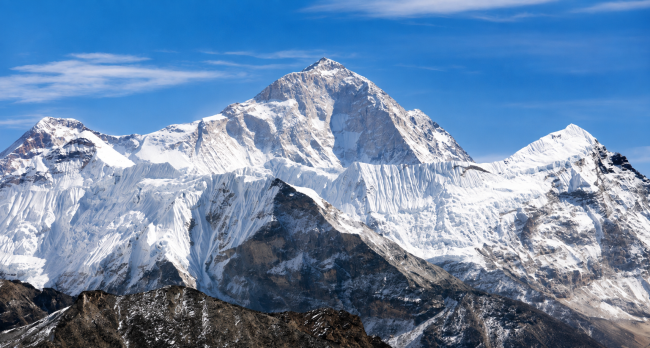
The main attraction is the Kanchenjunga massif, including its major summits and surrounding peaks. Trekkers may also see Jannu, Kabru, Rathong, Talung, the Twins, Nepal Peak, and other Himalayan mountains.
The northern region features glaciers associated with Kanchenjunga and Jannu, while the southern side provides views toward the Yalung Glacier.
The trek also passes near high-altitude lakes and alpine water bodies, including areas around Lhonak, Dudh Pokhari, and other seasonal or route-dependent glacial lakes.
One of the strongest reasons to choose the Kanchenjunga Circuit is the opportunity to experience authentic mountain culture.
The region is home to communities including Limbu, Rai, Sherpa, and other Himalayan groups. Lower valleys feature agricultural communities, while the higher settlements have stronger Tibetan Buddhist cultural influences.
Important villages include:
Ghunsa is particularly important culturally and geographically. It is also an excellent place for acclimatization before moving farther into the high mountains.
Local people traditionally depend on agriculture, livestock, trade, and tourism. Respecting local customs, homes, religious sites, and environmental practices is an important part of responsible trekking.
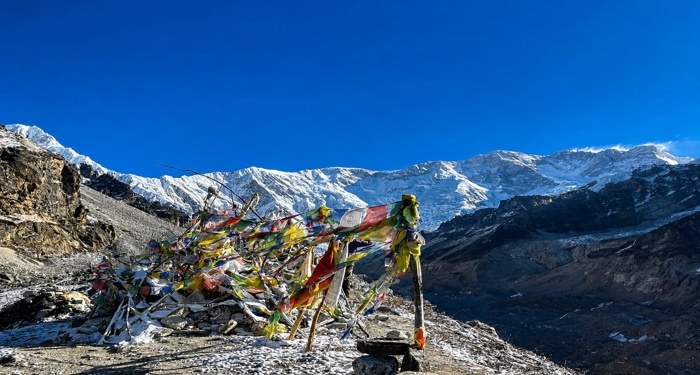
The higher Kanchenjunga region contains strong Tibetan Buddhist influences. Monasteries, prayer flags, mani walls, and traditional religious practices form an important part of the cultural experience.
Ghunsa Monastery is one of the significant religious sites encountered along the route. Phale also has a strong Tibetan cultural identity and a monastery associated with the local community.
For many trekkers, visiting these sites provides a welcome cultural dimension alongside the physical adventure.
The Kanchenjunga Conservation Area protects a remarkable variety of Himalayan ecosystems.
Depending on the season, weather, and luck, trekkers may encounter signs of wildlife including red pandas, Himalayan black bears, blue sheep, and snow leopards. The region also supports many species of Himalayan birds.
Vegetation changes dramatically with elevation. Lower sections feature lush forests and agricultural land, including cardamom plantations. Rhododendron, bamboo, pine, and mixed forests dominate many middle elevations.
As the trail climbs above the tree line, forests gradually disappear and are replaced by alpine shrubs, rocky terrain, glaciers, and snow.
The best seasons for the Kanchenjunga Circuit are generally spring and autumn.
Spring offers relatively stable weather and beautiful flowering forests. Rhododendrons add color to lower and middle-elevation sections.
March can still be cold at high elevations, while April and May generally become warmer.
Autumn is one of the most popular seasons for trekking in Nepal. Following the monsoon, the atmosphere often becomes clearer, providing excellent mountain visibility.
October is particularly attractive for trekkers who want stable weather and clear Himalayan views. November is generally dry but significantly colder at high altitude.
Winter brings freezing temperatures and increased snowfall. High passes can become difficult or unsafe, so winter trekking requires specialist planning and favorable conditions.
Heavy rainfall can make lower trails muddy and slippery. Clouds can also reduce mountain visibility, while road travel toward the trailhead may become more difficult.
The Kanchenjunga region is a restricted trekking area, so trekkers must obtain the required permits before entering the route.
The main permits include the Kanchenjunga Conservation Area Project (KCAP) Entry Permit and the applicable Restricted Area Permit.
The source information indicates that the KCAP permit is priced at NPR 2,000 per person, while the restricted-area permit is charged according to the applicable trekking section and duration.
Because permit rules and government fees can change, Himalayan Adventure Intl Treks confirms the current requirements and applicable fees before departure.
Independent solo trekking is not permitted on the restricted sections. Trekkers should travel through a registered trekking agency with a licensed guide and the required group arrangement.
A valid passport, Nepal visa, photographs, and relevant trekking documentation are normally required for permit processing.
Travel insurance is strongly recommended for this trek and should specifically cover high-altitude trekking and emergency evacuation.
Before purchasing insurance, check that the policy covers the maximum altitude of your itinerary. It should also provide suitable coverage for medical treatment, emergency evacuation, trip interruption, and other relevant travel risks.
Because the Kanchenjunga region is remote, emergency support can take longer than in popular trekking regions. Comprehensive insurance is therefore an important part of responsible preparation.
Accommodation is primarily provided by simple teahouses and family-run lodges.
Facilities become increasingly basic as you move higher. Lower settlements may offer relatively comfortable rooms, while high-altitude lodges generally have simple twin-sharing rooms, basic mattresses, shared bathrooms, and limited electricity.
Ghunsa has comparatively better facilities than the higher settlements. Kambachen and Lhonak have much more basic accommodation.
Pangpema is normally visited as a day excursion from Lhonak rather than as an overnight stop.
Trekkers should bring a warm sleeping bag because nights can become extremely cold, especially at high elevations.
Food on the Kanchenjunga Circuit is simple, warm, filling, and designed to provide energy for long trekking days.
Common meals include:
Dal bhat remains one of the most useful trekking meals because it combines carbohydrates, protein, and vegetables.
Vegetarian meals are widely available. Vegan trekkers should communicate their dietary requirements clearly because dairy products such as butter and milk are commonly used.
For drinking water, trekkers can use boiled water or a reliable purification system. A reusable bottle and water purification tablets or a filtration system are recommended.
The total Kanchenjunga Circuit Trek cost depends on the duration, group size, transportation, accommodation, guide and porter services, permits, and service level.
The source material indicates a broad trekking cost range of approximately USD 1,500–3,000 per person.
Major expenses can include:
Guide services may cost approximately USD 30–35 per day, while porter services may be around USD 25 per day, depending on the arrangement.
At Himalayan Adventure Intl Treks, we provide a transparent quotation based on your preferred itinerary and services. Larger groups can often reduce the per-person cost.
Because this is a long and remote trek, careful packing is essential.
Recommended equipment includes:
Avoid overpacking. A lighter backpack makes long ascents and descents significantly easier.
Start preparing several weeks before your trip. Regular walking, hiking, stair climbing, cycling, and cardiovascular exercise can improve endurance.
Include longer weekend hikes in your preparation program. Practice walking with the backpack you expect to carry during the trek.
Strengthening your legs and core is also useful because the route contains repeated ascents and descents.
Most importantly, understand that fitness does not completely prevent altitude sickness. Proper acclimatization, hydration, gradual ascent, adequate rest, and listening to your guide are essential.
The Kanchenjunga Circuit is remote, challenging, and logistically demanding. Traveling with an experienced local trekking company makes the journey easier to manage.
Himalayan Adventure Intl Treks provides professional trekking support for travelers exploring Nepal’s mountains. Our services can include:
Our local knowledge helps us adapt the itinerary when weather, trail conditions, transportation, or individual trekking requirements change.
Yes. It is considered a demanding high-altitude trek because of its long duration, remote terrain, steep climbs, high passes, and elevations above 5,000 m.
A complete itinerary generally takes around 22–26 days, including transportation, acclimatization, base camp excursions, and trekking days.
The route reaches approximately 5,200 m, while Pangpema, the North Base Camp viewpoint, is around 5,143 m.
October and April are among the most attractive months, with generally favorable weather and good mountain visibility. March, May, September, and November can also be suitable depending on conditions.
The restricted sections require trekkers to follow the applicable government regulations, including licensed guide and group requirements. Himalayan Adventure Intl Treks can arrange the required local guide and permits.
The complete circuit is better suited to experienced trekkers or physically well-prepared hikers. Beginners should consider shorter and less demanding Himalayan routes before attempting the full circuit.
Yes, teahouses and basic lodges operate along much of the established route, although facilities become increasingly limited at high altitude.
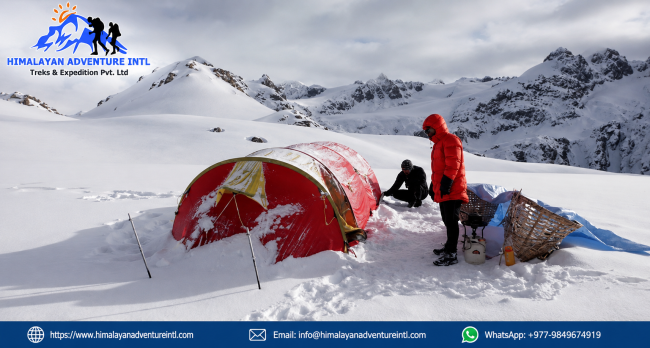
Most standard itineraries use teahouses. However, camping can be useful as a backup or for sections where accommodation is limited, particularly around remote high-altitude areas.
Yes. The trek provides exceptional views of the Kanchenjunga massif, especially around Pangpema, Oktang, and the high-pass sections.
Comprehensive travel insurance with high-altitude trekking and emergency evacuation coverage is strongly recommended.
The Kanchenjunga Circuit Trek is one of Nepal’s finest choices for travelers seeking solitude, wilderness, culture, and serious Himalayan adventure. The journey combines the North and South Base Camps of the world’s third-highest mountain with remote villages, dramatic glaciers, high mountain passes, diverse forests, and extraordinary Himalayan panoramas.
This is not a short or easy trek. The altitude, rugged terrain, long walking days, limited facilities, and remote location demand good preparation. However, for trekkers who are ready for the challenge, the rewards are exceptional.
From the forests around Taplejung and Sekathum to the Tibetan-influenced village of Ghunsa, the glacier landscapes around Lhonak, the spectacular Pangpema viewpoint, and the dramatic passes leading toward the southern base camp, every section offers a different experience.
With proper acclimatization, suitable equipment, reliable permits, good physical preparation, and an experienced trekking team, the Kanchenjunga Circuit can become one of the most memorable adventures of your life.
Himalayan Adventure Intl Treks is ready to help you plan your Kanchenjunga adventure with a carefully designed itinerary, experienced local guides, transportation, permits, accommodation, and personalized trekking support.
Plan your Kanchenjunga Circuit Trek with Himalayan Adventure Intl Treks and discover one of Nepal’s most remote and spectacular Himalayan journeys.
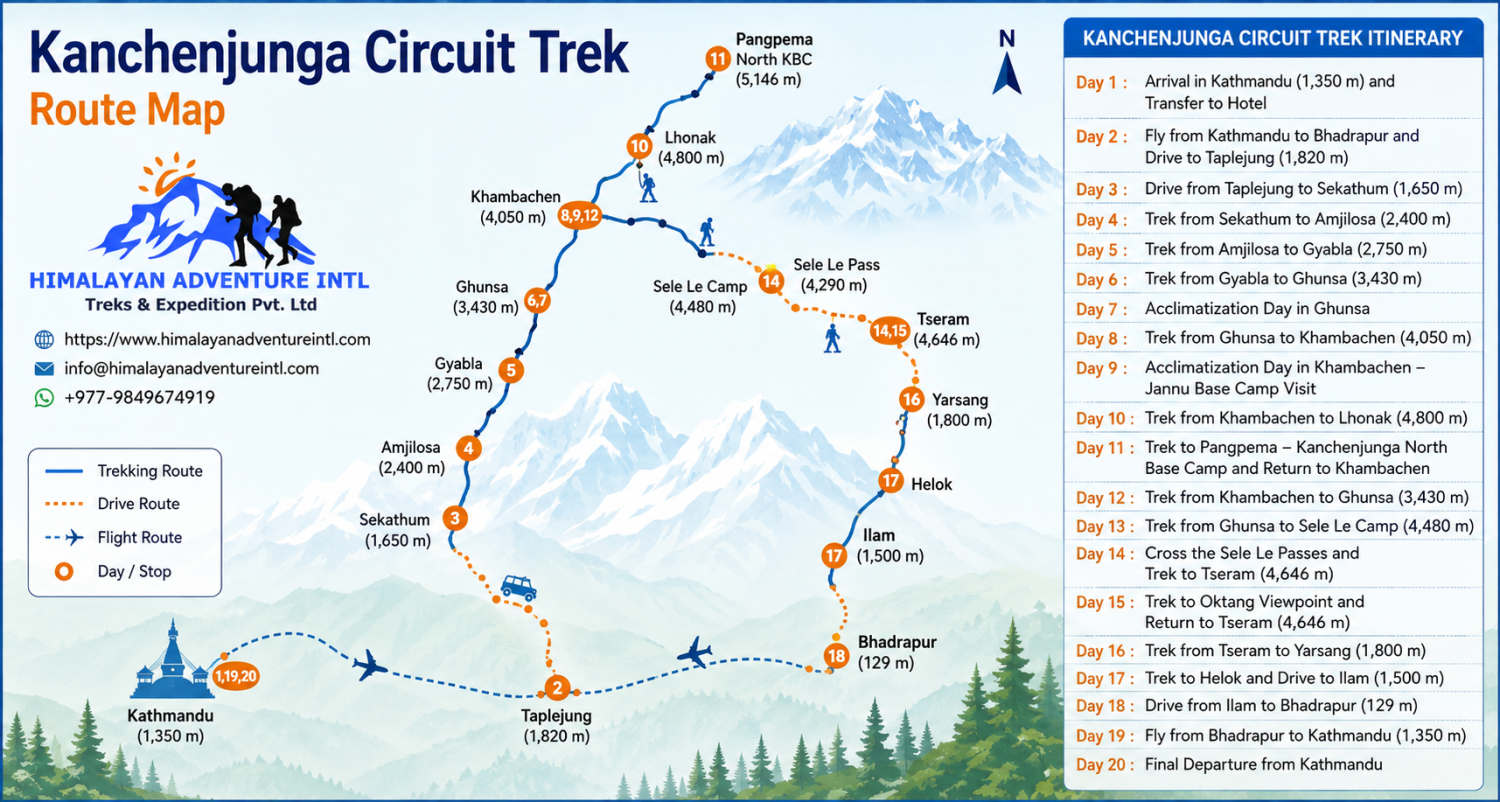
Your exciting Kanchenjunga Circuit Trek in Nepal begins with your arrival at Tribhuvan International Airport in Kathmandu. Situated at approximately 1,350 meters above sea level, Kathmandu is the cultural, historical, and commercial center of Nepal and the main gateway to the Himalayan trekking regions.
After completing airport immigration, baggage collection, and customs formalities, a representative from Himalayan Adventure Intl Treks will welcome you outside the terminal. You will then be transferred comfortably to your hotel in Kathmandu.
After checking into your hotel, you can relax and recover from your international journey. Depending on your arrival time and energy level, you may explore the nearby streets, visit local shops, or enjoy traditional Nepali cuisine at a nearby restaurant.
Later, your trekking guide will meet you for a briefing about the Kanchenjunga Circuit Trek. Important information about the route, altitude, accommodation, meals, trekking equipment, permits, safety procedures, and daily walking schedule will be discussed.
Your team will also check your trekking equipment to ensure that everything required for the remote and high-altitude journey is ready. If anything is missing, your guide can recommend local shops where you can purchase or rent trekking equipment.
In the evening, enjoy a welcome dinner featuring delicious Nepali cuisine and meet your trekking team.
Overnight: Hotel in Kathmandu
Altitude: 1,350 m
Meals: Welcome dinner
Activity: Arrival, hotel transfer, trek briefing
Today begins with an early morning flight from Kathmandu to Bhadrapur, located in southeastern Nepal. The short domestic flight takes you from the Kathmandu Valley toward the beautiful eastern region of the country.
After landing at Bhadrapur Airport, you will meet your local transportation team and begin the scenic drive toward Taplejung, one of the principal gateways to the Kanchenjunga region.
The road journey takes you through changing landscapes, beginning with the warmer lowlands and gradually climbing into the green hills of eastern Nepal. Along the way, you can observe terraced farms, rivers, forests, traditional villages, and local communities.
Eastern Nepal is known for its lush hills and diverse cultures. The journey provides an excellent opportunity to experience rural Nepal away from the major tourist centers.
As the road climbs toward Taplejung, the landscape becomes increasingly mountainous. You will notice changes in vegetation, temperature, architecture, and agricultural practices.
Taplejung is an important starting point for adventures into the Kanchenjunga Conservation Area. After reaching the town, check into your accommodation and rest after the long journey.
Your guide will also confirm the next day's transportation and trekking arrangements. Since the following day begins the approach toward Sekathum, take advantage of the evening to organize your backpack and trekking equipment.
The drive may take several hours depending on road and weather conditions, but the changing scenery makes it an interesting part of the Kanchenjunga adventure.
Overnight: Lodge in Taplejung
Altitude: 1,820 m
Meals: Breakfast, lunch, and dinner
Activity: Flight and scenic mountain drive
After breakfast, you will continue the journey by road from Taplejung toward Sekathum, the starting point of the main trekking section of your Kanchenjunga Circuit adventure.
The drive follows rugged mountain roads through remote areas of eastern Nepal. The road conditions can vary depending on weather, season, and local circumstances, so the journey itself becomes part of the adventure.
As you travel deeper into the Kanchenjunga region, you will encounter traditional villages, terraced hillsides, forests, mountain streams, and dramatic valleys. The surrounding scenery provides an excellent introduction to the remote landscapes that you will explore on foot.
Sekathum is located near the entrance to the trekking route toward the northern Kanchenjunga region. The village and surrounding area are characterized by steep hills, forested slopes, and rushing mountain rivers.
Although today's journey is primarily by vehicle, it is important to conserve your energy because trekking begins shortly afterward. Your guide will make sure that your trekking equipment and personal belongings are organized before you begin walking.
Upon arrival in Sekathum, you can explore the surrounding area, relax at the lodge, and enjoy the peaceful mountain environment.
This remote settlement offers a first taste of the quieter side of Nepal, far from the crowded trekking routes around Everest and Annapurna.
Your guide will provide information about the next day's trek to Amjilosa, including trail conditions, walking pace, and safety considerations.
Enjoy a warm dinner and prepare for the first major trekking day.
Overnight: Lodge in Sekathum
Altitude: 1,650 m
Meals: Breakfast, lunch, and dinner
Activity: Mountain road journey
Today marks the official beginning of your Kanchenjunga Circuit Trek on foot. After breakfast, you will leave Sekathum and begin trekking toward the beautiful mountain settlement of Amjilosa at approximately 2,400 meters.
The trail immediately introduces you to the rugged character of the Kanchenjunga region. You will walk through forests, cross mountain streams, and follow narrow paths carved into steep Himalayan slopes.
The route includes a mixture of ascents and descents, so maintaining a comfortable and steady pace is important. Your guide will help you manage the trail and choose appropriate places for rest.
As you continue deeper into the valley, the surroundings become increasingly peaceful. You may hear the sounds of waterfalls and rushing rivers while walking through dense vegetation.
The lower sections of the trail contain a mixture of subtropical plants and forest species. As the elevation increases, the vegetation gradually changes.
Amjilosa is a small and traditional mountain settlement surrounded by forested hills. The village provides an excellent opportunity to observe the simple lifestyle of communities living in the remote Kanchenjunga region.
The local people have developed their livelihoods around agriculture, livestock, tourism, and traditional mountain activities. Staying overnight in the village allows you to experience authentic Himalayan hospitality.
Today's trek is not extremely high in altitude, but the trail can be physically demanding because of the uneven terrain and repeated climbs and descents.
After reaching Amjilosa, enjoy a well-earned meal and relax at the lodge. Your guide will brief you about tomorrow's trek toward Gyabla.
Overnight: Teahouse/lodge in Amjilosa
Altitude: 2,400 m
Meals: Breakfast, lunch, and dinner
Activity: Trekking through forests and mountain valleys
After breakfast, you will continue the Kanchenjunga Trek from Amjilosa toward Gyabla, situated at approximately 2,750 meters.
The trail continues through beautiful forests and follows the mountain valley. You will encounter a mixture of steep sections, stone paths, suspension bridges, streams, and waterfalls.
The eastern Himalayan forests are particularly attractive during spring when rhododendrons bloom. The colorful flowers contrast beautifully with the surrounding green vegetation and rugged mountain landscape.
As you gain altitude, the scenery gradually changes. The forest becomes more alpine, and the surrounding hills become steeper and more dramatic.
The trail offers occasional views across the valley and toward distant mountain slopes. The sound of flowing rivers continues to accompany you as you progress toward Gyabla.
Although today's walking distance may not seem extreme, the elevation gain makes the trek more demanding. Walking slowly and maintaining a consistent rhythm will help conserve energy.
Gyabla is a small settlement surrounded by beautiful mountain scenery. It is an excellent place to rest and experience local village life.
Once you arrive at the lodge, you can enjoy a warm meal and relax. This is also a good opportunity to discuss altitude awareness with your guide because the route will soon climb beyond 3,000 meters.
Your guide will monitor your condition and ensure that you are prepared for the next stage toward Ghunsa.
Spend the evening enjoying the peaceful surroundings of Gyabla and preparing your belongings for tomorrow.
Overnight: Teahouse/lodge in Gyabla
Altitude: 2,750 m
Meals: Breakfast, lunch, and dinner
Activity: Forest trekking and village exploration
Today's destination is Ghunsa, one of the most important villages on the Kanchenjunga trekking route. After breakfast, you will begin the trek from Gyabla and gradually climb toward the village at approximately 3,430 meters.
The trail passes through increasingly mountainous terrain and beautiful forests. As you gain elevation, the vegetation changes from dense lower-altitude forest toward coniferous and alpine vegetation.
The path follows the valley and includes rocky sections, forest trails, small bridges, and occasional steep climbs. The landscape becomes more dramatic as you approach Ghunsa.
Along the way, you may encounter traditional mountain houses, grazing animals, prayer flags, and local residents carrying supplies between villages.
Ghunsa is culturally significant because of its strong Tibetan Buddhist influence. Traditional houses, mani walls, prayer flags, and other Buddhist features create a distinctive Himalayan atmosphere.
The village is also an important acclimatization point before continuing toward Khambachen and higher elevations.
Upon arrival in Ghunsa, settle into your lodge and enjoy a warm meal. Because you are now above 3,400 meters, it is important to begin paying close attention to hydration and altitude symptoms.
Your guide will explain the acclimatization schedule and activities planned for tomorrow.
The surrounding mountains provide beautiful photographic opportunities, particularly in the afternoon when the weather is clear.
Spend a relaxing evening in Ghunsa. Avoid strenuous activity and allow your body to begin adapting to the higher altitude.
Overnight: Teahouse/lodge in Ghunsa
Altitude: 3,430 m
Meals: Breakfast, lunch, and dinner
Activity: Trekking and cultural exploration
Today is an important acclimatization day in Ghunsa. Instead of immediately climbing higher, you will spend the day allowing your body to adapt to the altitude.
Acclimatization is essential during the Kanchenjunga Circuit Trek because the route eventually reaches elevations above 5,000 meters. A gradual ascent reduces the risk associated with altitude-related problems and gives your body time to adjust.
Your guide will organize a short hike around Ghunsa and the surrounding area. The objective is to remain active without exhausting yourself.
You can explore the traditional village, observe local homes, visit nearby cultural sites, or walk to a suitable viewpoint. The area provides beautiful views of the surrounding mountains and forested slopes.
Ghunsa is one of the most attractive settlements on the Kanchenjunga route. The village has a distinct Tibetan-influenced character, with prayer flags, mani stones, wooden houses, and Buddhist cultural traditions.
During the acclimatization day, make sure you drink enough water and eat nutritious meals. Avoid alcohol and unnecessary strenuous activity.
You should also inform your guide if you experience symptoms such as persistent headache, nausea, unusual tiredness, dizziness, or difficulty breathing.
The goal is to finish the day feeling healthy and prepared for the higher-altitude journey to Khambachen.
After the short excursion, return to the lodge for lunch and relaxation. You can use the afternoon to prepare your backpack and equipment.
Overnight: Teahouse/lodge in Ghunsa
Altitude: 3,430 m
Meals: Breakfast, lunch, and dinner
Activity: Acclimatization hike and village exploration
Today you leave Ghunsa and enter a higher and more dramatic section of the Kanchenjunga Circuit Trek. Your destination is Khambachen, situated at approximately 4,050 meters.
The trail climbs gradually through coniferous forests and follows the mountain valley. As you gain elevation, the vegetation becomes thinner and the surrounding landscape becomes increasingly alpine.
You may encounter sections of rocky trail and areas affected by landslides, so careful walking is important. Your experienced guide will select the safest route according to current conditions.
As you approach Khambachen, the valley opens and enormous mountain walls begin to dominate the landscape. The surrounding Himalayan scenery becomes increasingly impressive.
The journey can be physically challenging because of the elevation gain. Walking slowly and taking regular breaks is more important than maintaining speed.
Khambachen is a remote mountain settlement surrounded by dramatic peaks and rocky landscapes. It is one of the key overnight stops before continuing toward Lhonak and Pangpema.
Upon arrival, settle into your accommodation and enjoy a warm meal. Because the temperature can become very cold at night, make sure your sleeping bag and warm clothing are ready.
The evening should be spent resting and hydrating. Tomorrow's acclimatization day will include an excursion toward the spectacular Jannu Base Camp area.
The mountain environment around Khambachen is especially impressive in clear weather, providing excellent opportunities for photography.
Overnight: Teahouse/lodge in Khambachen
Altitude: 4,050 m
Meals: Breakfast, lunch, and dinner
Activity: High-altitude trekking
Today is another important acclimatization day at Khambachen. You will undertake a high-altitude excursion toward the Jannu Base Camp area, depending on current trail, weather, and safety conditions.
Jannu, also known as Kumbhakarna, is one of the most dramatic mountains in the Kanchenjunga region. Its steep walls and spectacular Himalayan landscape make the area a major attraction for experienced trekkers and mountaineers.
The excursion allows you to gain additional altitude during the day while returning to Khambachen for overnight accommodation. This provides a valuable opportunity for your body to adapt before moving toward Lhonak and Pangpema.
The trail leads through rugged terrain characterized by rocky slopes, glaciers, moraines, and high mountain scenery. The views are especially impressive when the weather is clear.
Your guide will determine how far the group should proceed based on trail conditions and individual fitness.
Because this is a high-altitude excursion, walk slowly and take regular breaks. There is no need to rush. The purpose of the day is acclimatization and exploration rather than completing a difficult challenge.
After enjoying the Jannu landscape, return to Khambachen. The descent provides a chance to recover at a lower sleeping elevation.
In the afternoon, relax at the lodge, drink plenty of water, and prepare for the challenging trek toward Lhonak tomorrow.
Overnight: Teahouse/lodge in Khambachen
Altitude: 4,050 m
Meals: Breakfast, lunch, and dinner
Activity: Acclimatization and Jannu Base Camp excursion
Today is one of the most exciting stages of the northern Kanchenjunga Base Camp Trek. After breakfast, you will leave Khambachen and trek toward Lhonak, situated at approximately 4,800 meters.
The trail enters a remote high-altitude landscape where trees become increasingly sparse. The route passes through rocky terrain, glacial valleys, and moraine-covered areas.
As you progress, the mountains appear larger and more dramatic. The enormous Kanchenjunga massif dominates the surrounding landscape, creating an unforgettable Himalayan panorama.
Today's trek is physically demanding because of the high elevation. Even relatively short distances can feel difficult when walking above 4,000 meters. Maintaining a slow, steady pace is essential.
Your guide will monitor your physical condition throughout the day. Drink water regularly and communicate immediately if you feel unwell.
The sense of remoteness becomes particularly strong as you move farther away from permanent settlements. The landscape is wild, quiet, and spectacular.
Lhonak is situated on a high mountain plateau surrounded by dramatic peaks and glacial terrain. Accommodation here is basic, and temperatures can drop significantly after sunset.
After reaching Lhonak, enjoy a warm meal and rest. Prepare your clothing and equipment for tomorrow's major objective: Pangpema, the Kanchenjunga North Base Camp viewpoint.
An early start may be recommended tomorrow depending on weather and trail conditions.
Overnight: Teahouse/lodge in Lhonak
Altitude: 4,800 m
Meals: Breakfast, lunch, and dinner
Activity: High-altitude trekking
Today is one of the most important days of your Kanchenjunga Circuit Trek 20 Days itinerary. You will trek toward Pangpema, the famous Kanchenjunga North Base Camp viewpoint, before returning to Khambachen.
The journey begins early in the morning. The trail follows the remote high-altitude valley through rocky terrain, glaciers, and moraine landscapes.
As you approach Pangpema, the views of Kanchenjunga and surrounding Himalayan peaks become increasingly spectacular. The landscape provides a powerful sense of wilderness and adventure.
Pangpema is one of the most memorable viewpoints in the Kanchenjunga region. From here, you can appreciate the enormous scale of the Kanchenjunga massif and surrounding mountains.
Spend some time at the viewpoint, take photographs, enjoy the scenery, and celebrate reaching one of the major objectives of your trek.
Because of the high elevation, avoid excessive physical exertion and listen carefully to your guide's instructions.
After spending time at Pangpema, you will retrace your route and descend toward Khambachen.
Descending to a lower altitude provides welcome relief after the high-altitude excursion. The trail may feel easier as you gradually return to lower elevation.
Once you reach Khambachen, enjoy a warm dinner and rest.
Today's excursion is physically demanding, but reaching Pangpema is one of the greatest rewards of the entire Kanchenjunga adventure.
Overnight: Teahouse/lodge in Khambachen
Altitude: Khambachen 4,050 m; Pangpema above 5,000 m
Meals: Breakfast, lunch, and dinner
Activity: Pangpema excursion and descent
After the demanding Pangpema excursion, today's trek takes you back toward Ghunsa, where you will descend to approximately 3,430 meters.
The route follows the trail through the spectacular mountain valley and gradually returns toward greener landscapes.
As you lose altitude, the air becomes richer in oxygen, making walking and breathing more comfortable. The surrounding vegetation also becomes more noticeable as you descend.
The trail includes rocky sections and gradual downhill stretches. Although descending is generally easier for breathing, careful footwork is still necessary.
Along the way, you can enjoy different perspectives of the mountains and valleys you crossed earlier in the journey.
Returning to Ghunsa provides a valuable opportunity to rest before the next challenging section of the trek. From Ghunsa, you will begin the journey toward Sele Le Camp and cross the high Sele Le passes.
After reaching Ghunsa, check into your lodge and enjoy a warm meal. You can take time to wash, reorganize your backpack, and prepare warm clothing for the upcoming high-pass crossing.
Your guide will provide a detailed briefing about the next two days because the Sele Le section can be challenging depending on weather and trail conditions.
Enjoy a relaxing evening and get plenty of sleep.
Overnight: Teahouse/lodge in Ghunsa
Altitude: 3,430 m
Meals: Breakfast, lunch, and dinner
Activity: Descending trek
Today you leave Ghunsa and begin climbing toward Sele Le Camp, situated at approximately 4,480 meters.
The trail initially passes through forests before gradually entering a more exposed alpine environment. The ascent becomes steeper as you gain altitude.
The trail requires careful pacing because you are once again moving into a high-altitude environment. Your guide will establish a comfortable walking rhythm and schedule regular breaks.
As you climb higher, the views become increasingly expansive. Depending on weather and visibility, you may see surrounding Himalayan peaks and mountain ridges.
Sele Le Camp is located in a remote and rugged environment. Accommodation is basic, and facilities are limited compared with lower villages.
Because temperatures can become extremely cold at night, keep your warm clothing easily accessible and ensure your sleeping bag is properly prepared.
The evening should be focused on rest and preparation for tomorrow's high-pass crossing.
Your guide will check weather and trail conditions before the crossing. The Sele Le passes can be affected by snow, ice, wind, and poor visibility depending on the season.
Stay hydrated and eat enough food to maintain energy.
Although the climb to Sele Le Camp is demanding, reaching the camp marks an important stage of the Kanchenjunga Circuit Trek and positions you for the spectacular journey toward Tseram.
Overnight: Basic lodge/camp
Altitude: 4,480 m
Meals: Breakfast, lunch, and dinner
Activity: High-altitude ascent
Today is one of the most challenging and adventurous days of the Kanchenjunga Circuit Trek. You will cross the high Sele Le passes before descending toward Tseram.
The day begins with a climb through rugged alpine terrain. Depending on weather and season, snow may cover sections of the trail.
The pass crossing requires patience, physical endurance, and careful attention. Your guide will lead the group and select the safest route according to current conditions.
From the high ridges, you may enjoy spectacular panoramic views of the Himalayan landscape. The feeling of standing in such a remote mountain environment is unforgettable.
After crossing the high passes, the trail begins descending toward the southern Kanchenjunga region. The landscape gradually changes as you lose altitude.
The descent can be long, so use trekking poles if necessary and take care with every step.
Eventually, you will reach the area of Tseram, one of the important settlements on the southern side of the Kanchenjunga trekking route.
After arriving, enjoy a warm meal and rest. You will have completed one of the most demanding sections of the trek.
The southern landscape offers a different atmosphere from the northern side, and tomorrow you will explore one of its major attractions, Oktang Viewpoint.
Your guide will explain the next day's excursion and check your equipment.
Overnight: Teahouse/lodge in Tseram
Altitude: approximately 4,646 m
Meals: Breakfast, lunch, and dinner
Activity: Sele Le pass crossing and desc
Today you will explore the spectacular Oktang Viewpoint, one of the major highlights of the southern Kanchenjunga trekking route.
After an early breakfast, you begin the excursion from Tseram. The trail leads through a dramatic high-altitude environment containing rocky terrain, glacial landscapes, and impressive mountain views.
As you gain elevation, the surrounding Himalayan scenery becomes increasingly dramatic. The Oktang area provides an exceptional perspective toward the southern face of Mount Kanchenjunga.
The massive mountain walls, glaciers, and surrounding peaks create excellent photography opportunities.
Because the excursion takes place at high altitude, your guide will maintain a slow pace and schedule regular rest breaks.
The objective is to enjoy the landscape safely rather than rush toward the viewpoint.
Upon reaching the Oktang viewpoint area, take time to appreciate the surrounding mountains. This is one of the places where the enormous scale of the Kanchenjunga massif can truly be understood.
After spending sufficient time at the viewpoint, you will retrace the trail toward Tseram.
The return journey gradually lowers your altitude and allows your body to recover.
After arriving back at Tseram, enjoy a warm meal and relax at the lodge. Tomorrow begins the long descent toward lower elevations.
Overnight: Teahouse/lodge in Tseram
Altitude: approximately 4,646 m
Meals: Breakfast, lunch, and dinner
Activity: Oktang viewpoint excursion
Today marks a major change in the landscape as you begin descending from the high mountains toward Yarsang, located at approximately 1,800 meters.
After several days of trekking above 4,000 meters, the descent brings warmer temperatures, more oxygen, and increasingly green landscapes.
The trail passes through forests, streams, waterfalls, and lower mountain valleys. As you lose altitude, vegetation becomes denser and more diverse.
The contrast between today's environment and the rocky landscapes around Pangpema and Oktang is remarkable. You will experience the dramatic ecological diversity of eastern Nepal within a relatively short distance.
The descent may still require several hours of walking, and the uneven trail can be demanding on the knees. Trekking poles can be particularly useful today.
Along the way, you may encounter local villagers, porters, livestock, and agricultural areas.
Yarsang provides a comfortable lower-elevation stop after the demanding high-altitude portion of the journey.
Once you arrive, enjoy the warmer environment and relax at the lodge.
Your guide will confirm transportation arrangements for the following days because the trekking section is nearing its conclusion.
This is a good time to reflect on the extraordinary experiences of the past two weeks, including remote villages, mountain passes, glaciers, Pangpema, Jannu, and Oktang.
Overnight: Lodge/teahouse in Yarsang
Altitude: approximately 1,800 m
Meals: Breakfast, lunch, and dinner
Activity: Long descent through forests and valleys
Today is the final trekking stage of your Kanchenjunga Circuit Trek. After breakfast, you will continue walking toward Helok, where your trekking adventure comes to an end.
The trail passes through lower Himalayan landscapes, forests, villages, and agricultural areas. The environment is considerably warmer and greener than the high-altitude sections of the journey.
This final walking section provides an opportunity to enjoy the peaceful countryside of eastern Nepal before transitioning to road travel.
Upon reaching Helok, you will meet your vehicle and begin the scenic drive toward Ilam, a famous hill destination known for its tea gardens, lush landscapes, and beautiful mountain scenery.
The drive offers a fascinating transition from the remote Kanchenjunga region to one of eastern Nepal's most popular hill districts.
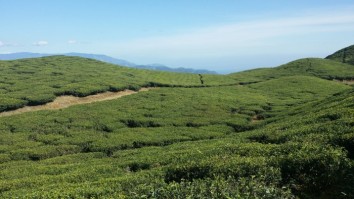
Ilam is famous throughout Nepal for its tea production. Its rolling green hills and tea plantations create a beautiful contrast to the rugged Himalayan landscapes you experienced earlier.
Depending on your arrival time, you may explore the town or enjoy the surrounding scenery.
After many days of trekking, Ilam provides a comfortable opportunity to relax.
Enjoy dinner and reflect on your successful journey around the Kanchenjunga region.
Your guide will also confirm the following day's road transfer to Bhadrapur.
Overnight: Hotel in Ilam
Altitude: approximately 1,500 m
Meals: Breakfast, lunch, and dinner
Activity: Final trekking stage and scenic drive
After breakfast, you will leave Ilam and begin the drive toward Bhadrapur, located at approximately 129 meters above sea level.
The journey takes you from the green hills of eastern Nepal toward the warmer lowland region.
As the road descends, the landscape gradually changes. You will pass through agricultural areas, villages, forests, rivers, and local towns.
The drive provides another opportunity to observe Nepal's remarkable geographical diversity. In a single journey, you move from high Himalayan terrain through middle hills and finally into the lowland plains.
Bhadrapur is an important transportation hub for eastern Nepal and is home to the airport that connects the region with Kathmandu.
Upon arrival in Bhadrapur, check into your hotel and rest.
The warmer climate may feel very different after the cold mountain environment of Kanchenjunga.
Depending on your schedule, you can take a relaxing walk around the local area or simply rest at the hotel.
Your guide will confirm the flight schedule for tomorrow and arrange the airport transfer.
This is the final overnight stop outside Kathmandu before returning to the capital.
Use the evening to organize your belongings and ensure that all personal items are packed before the flight.
Enjoy your final evening in eastern Nepal.
Overnight: Hotel in Bhadrapur
Altitude: approximately 129 m
Meals: Breakfast, lunch, and dinner
Activity: Scenic drive
After breakfast, you will transfer to Bhadrapur Airport for your flight back to Kathmandu.
The flight provides a convenient connection between eastern Nepal and the capital. Depending on weather conditions and visibility, you may enjoy views of the surrounding hills and Himalayan landscapes during the flight.
Upon arrival at Tribhuvan International Airport, our representative from Himalayan Adventure Intl Treks will meet you and transfer you to your hotel.
After checking in, the remainder of the day is free for relaxation.
You may choose to explore Kathmandu's historic neighborhoods, visit local markets, enjoy traditional Nepali cuisine, or purchase souvenirs for family and friends.
Popular souvenirs include Nepali tea, handmade crafts, traditional clothing, prayer flags, handicrafts, and locally produced products.
You may also simply relax at your hotel after completing the demanding Kanchenjunga Circuit Trek.
In the evening, you can celebrate the successful completion of your Himalayan adventure with your trekking team.
This is an opportunity to share memories and photographs from the journey and thank your guides and porters.
Enjoy a comfortable final evening in Kathmandu.
Overnight: Hotel in Kathmandu
Altitude: 1,350 m
Meals: Breakfast
Activity: Flight and leisure
Today marks the final day of your 20-day Kanchenjunga Circuit Trek in Nepal.
Depending on your international flight schedule, you may have free time in Kathmandu before departing. You can enjoy breakfast at the hotel and spend your remaining time relaxing or shopping for final souvenirs.
A representative from Himalayan Adventure Intl Treks will arrange your airport transfer according to your international flight departure time.
As you travel toward Tribhuvan International Airport, you can reflect on your remarkable Himalayan journey.
During the past 20 days, you have traveled from Kathmandu to eastern Nepal, explored remote mountain villages, crossed high-altitude landscapes, visited Jannu Base Camp, reached Lhonak and Pangpema, crossed the Sele Le passes, explored the southern Kanchenjunga region, and visited Oktang Viewpoint.
The Kanchenjunga Circuit Trek is more than a mountain journey. It is an opportunity to experience remote Himalayan culture, traditional villages, diverse landscapes, and the extraordinary beauty of one of the world's greatest mountain regions.
We hope the memories of Kanchenjunga, the local communities, Himalayan trails, glaciers, forests, and mountain panoramas remain with you long after returning home.
Thank you for choosing Himalayan Adventure Intl Treks. We look forward to welcoming you again for another adventure in Nepal.
Overnight: Not applicable
Altitude: Kathmandu 1,350 m
Meals: Breakfast
Activity: Airport transfer and international departure
The Kanchenjunga Circuit Trek is one of the most remote, spectacular, and rewarding trekking adventures in Nepal. Located in the far-eastern Himalayas, the trek takes travelers deep into the Kanchenjunga Conservation Area, where dramatic mountain landscapes, traditional Himalayan villages, forests, glaciers, high-altitude valleys, and centuries-old cultures come together.
For travelers planning this adventure with Himalayan Adventure Intl Treks, the Kanchenjunga Circuit Trek normally requires around 18–24 days, depending on the selected itinerary, transportation, acclimatization requirements, and whether you trek to both the North and South Base Camps. A standard full circuit is commonly planned for approximately 21 days.
The trek reaches the Kanchenjunga North Base Camp at Pangpema, approximately 5,140–5,143 meters, and a full circuit itinerary can also include the South Base Camp at Oktang, around 4,730 meters, connected through the high mountain pass system around Sele La and Mirgin La.
Because Kanchenjunga is a remote restricted trekking region, the total cost is generally higher than that of shorter and more accessible trekking routes in Nepal. Transportation to eastern Nepal, domestic flights, private or shared jeep transfers, licensed guides, permits, food, accommodation, porters, and the longer duration all contribute to the overall budget.
Current published 2026 market prices for organized Kanchenjunga Circuit packages commonly fall roughly within the USD 2,000–3,500+ per person range, depending on group size, itinerary, transportation, accommodation standard, inclusions, and agency services. This is a market reference rather than a fixed Himalayan Adventure Intl Treks price; your final quotation should be based on your exact travel dates, group size, route, and service requirements.
The most important expenses include:
The Kanchenjunga Conservation Area is officially listed as a protected area of approximately 2,035 square kilometers, established in 1997, and is recognized for its glaciers, high peaks, biodiversity, cultural diversity, and communities living in the region.
Kanchenjunga is one of Nepal's most impressive Himalayan destinations. At 8,586 meters, Mount Kanchenjunga is the world's third-highest mountain. The trekking region lies in eastern Nepal close to the borders with India and Tibet, making the journey feel significantly more remote than many of Nepal's better-known trekking routes.
The Kanchenjunga Trek is particularly attractive to travelers who want an authentic Himalayan experience away from heavily developed trekking corridors.
The route passes through changing landscapes, beginning with lower-elevation valleys, terraced agricultural land, rivers, waterfalls, cardamom plantations, bamboo forests, rhododendron forests, and traditional settlements before gradually reaching pine forests, alpine meadows, glacial valleys, moraines, and high mountain landscapes.
The source itinerary supplied for this article describes an 18-day North Base Camp journey beginning with a flight from Kathmandu to Bhadrapur and continuing through Phidim and Taplejung before entering the trekking route. It reaches Sinuwa, Taplethok, Amjilosa, Gyabla, Ghunsa, Khambachen, Lhonak, and Kanchenjunga North Base Camp before returning through Phaley, Amjilosa, Taplethok, Sinuwa, and Taplejung.
A full Kanchenjunga Circuit Trek, however, is longer because it combines the North and South Base Camp areas and includes the high pass traverse. For this reason, travelers should distinguish between a Kanchenjunga North Base Camp Trek and a full Kanchenjunga Circuit Trek when comparing prices.
The exact Kanchenjunga Circuit Trek cost depends on the number of trekkers, itinerary length, transportation, accommodation, guide and porter requirements, and the standard of service selected.
For 2026, published commercial package prices provide a useful market benchmark. Current examples range from approximately USD 1,650 to USD 3,500 or more per person, while many full-service 21-day packages are advertised around USD 2,000–2,800 per person. Larger groups generally receive lower per-person rates because transportation, guide, and logistical costs can be shared.
For planning purposes, travelers can think about the budget in three broad categories:
A budget-oriented trek generally uses:
A realistic planning range for a fully organized budget-to-standard trek is approximately USD 2,000–2,400 per person, depending on the group size and exact itinerary.
A standard private or small-group trip generally provides:
A reasonable current market planning range is approximately USD 2,300–2,900 per person. Published 2026 packages from several Nepal operators fall around this range.
A premium package can cost USD 3,000–3,500 or more per person, particularly when the trip includes private transportation, upgraded Kathmandu hotels, additional acclimatization days, larger staff support, premium domestic transportation, or highly customized services.
Because Kanchenjunga is remote, paying more does not necessarily mean luxury accommodation throughout the trekking route. At higher elevations, accommodation choices remain limited. A higher price usually reflects better logistics, private transportation, experienced staff, contingency planning, and customized services.
Understanding where your money goes is one of the best ways to plan the trek correctly.
Kanchenjunga includes restricted trekking areas, so foreign travelers need the appropriate trekking authorization arranged through a registered trekking agency.
The Department of Immigration's current information lists Taplejung restricted-area permits at USD 20 per person per week for the first four weeks, with USD 25 per week beyond four weeks. The department also states that restricted-area trekking permits are obtained through authorized trekking agencies rather than individually.
Permit regulations can change, so Himalayan Adventure Intl Treks should confirm the applicable fee at the time of booking.
The trek also enters the Kanchenjunga Conservation Area.
The Nepal Tourism Board currently lists the Kanchenjunga Conservation Area entrance fee at:
The Nepal Tourism Board's destination information also identifies Kanchenjunga as a trekking and mountaineering destination with tea-house and camping accommodation and recommends March–May and September–November as the best seasons.
Because government fees can be revised, travelers should always confirm the current permit structure before departure.
A licensed trekking guide is one of the most important components of the Kanchenjunga Circuit Trek.
The guide helps with:
Current market estimates for a licensed guide are commonly around USD 30–40 per day, although the actual cost depends on experience, language skills, insurance, itinerary, and agency arrangements.
For a 21-day trip, guide-related costs can therefore represent a significant part of the total package price.
Hiring a porter is strongly recommended for travelers who want to reduce the physical burden of carrying a large backpack.
A porter can carry trekking equipment, clothing, sleeping bags, and other personal luggage, allowing trekkers to walk with a smaller daypack.
Current market estimates often place porter costs around USD 22–30 per day, depending on the service arrangement and whether the porter works directly for an agency.
A porter may serve one or two trekkers depending on luggage weight and the agency's operating standards.
The eastern approach is an important part of the Kanchenjunga Trek cost.
The supplied itinerary begins with a flight from Kathmandu to Bhadrapur, followed by ground transportation toward Phidim and Taplejung. The source itinerary states that the Kathmandu–Bhadrapur flight takes approximately 45 minutes, followed by about four hours of driving to Phidim.
Domestic flight prices vary according to season, booking time, airline, availability, and baggage requirements. A return Kathmandu–Bhadrapur flight can form a significant portion of the overall budget.
After reaching Bhadrapur, travelers need road transportation toward the Kanchenjunga trailhead.
Depending on the itinerary, this may involve:
Bhadrapur → Phidim → Taplejung → trekking trailhead
and return transportation at the end.
Private jeeps cost more but provide greater flexibility. Shared jeeps are generally more economical.
Remote-road transportation is one reason the Kanchenjunga Trek is more expensive than many popular trekking routes.
Accommodation along the Kanchenjunga route is generally basic.
Tea houses and lodges provide rooms, beds, blankets, and shared facilities. In some remote sections, accommodation options are limited, so trekkers should not expect the same variety of hotels found around Everest or Annapurna.
The Nepal Tourism Board identifies both tea houses and camping as accommodation options in the Kanchenjunga Conservation Area.
The cost of accommodation depends on:
A full-board package normally includes:
Typical mountain meals include:
Food becomes progressively more expensive as altitude and transportation difficulty increase.
Many Kanchenjunga packages include one or two nights in Kathmandu before and after the trek.
Hotel prices vary considerably depending on location and hotel category.
Budget hotels are inexpensive, while four- and five-star properties can substantially increase the total package cost.
If you want to keep the Kanchenjunga Trek cost low, a comfortable three-star or similar hotel can provide a good balance between convenience and price.
Travel insurance is highly recommended for the Kanchenjunga Circuit.
Because the trek reaches more than 5,000 meters and takes place in a remote region, insurance should ideally cover:
Insurance is normally a personal expense unless specifically included in your trekking package.
Group size has a major influence on the price.
A solo traveler generally pays more because many fixed costs cannot be divided among several people.
A group of two can share:
A group of four to six can often achieve better value because the cost of private vehicles and staff is distributed among more travelers.
Larger groups can reduce the average per-person price further, although the Kanchenjunga Circuit is best experienced in manageable small groups.
As a general market benchmark, published 2026 prices show significant reductions as group size increases. One current 21-day package, for example, lists prices ranging from approximately USD 2,690 for one traveler to around USD 2,390 for groups of 19–24, demonstrating how group size can influence pricing.
For Himalayan Adventure Intl Treks, the final price should therefore be quoted according to:
Number of trekkers + number of trekking days + transportation + accommodation + guide/porter requirements + inclusions.
A properly organized package from Himalayan Adventure Intl Treks can be designed to include most essential trekking expenses.
Typical inclusions may include:
Exact inclusions should always be confirmed in the written quotation before booking.
Personal expenses are usually excluded from the package price.
Common exclusions include:
It is important to read the inclusion and exclusion section carefully before making a booking.
The full Kanchenjunga Circuit is normally longer than the North Base Camp-only itinerary. A 21-day itinerary can be designed to combine the northern and southern sides of Kanchenjunga with a high-pass crossing.
The following structure is a practical outline for travelers considering the complete circuit.
Your Kanchenjunga adventure begins with travel from Kathmandu toward eastern Nepal.
The supplied route plan starts with a flight from Kathmandu to Bhadrapur and then a drive to Phidim. The flight is approximately 45 minutes, while the road journey to Phidim takes around four hours according to the supplied itinerary.
This is the beginning of your transition from urban Nepal into the remote eastern Himalayan landscape.
From Phidim, the journey continues by road to Taplejung.
The supplied itinerary places Taplejung at approximately 1,820 meters and Siekathum at around 1600 meters. The route follows traditional settlements, terraced farmland, and the Tamur River.
The trail continues alongside the Tamur River.
This is an important ascending day.
The route crosses a suspension bridge, passes cardamom fields, continues toward Sekathum, and moves through dense forest before reaching Amjilosa.
Amjilosa is approximately 2,310 meters.
The landscape becomes increasingly Himalayan.
You walk through bamboo, fir, and rhododendron forests and cross small bridges and streams.
Gyabla stands at approximately 2,725 meters.
The trail climbs toward Ghunsa at approximately 3,400 meters.
The route passes through Phale, a Tibetan refugee settlement, and then continues through pine and conifer forests.
Ghunsa is one of the major villages and acclimatization points on the route.
A rest and acclimatization day is essential before climbing farther toward Khambachen and Lhonak.
Short hikes around Ghunsa help the body adjust to increasing elevation.
The supplied itinerary specifically includes a rest day at approximately 3,400 meters.
The trail climbs toward Khambachen at approximately 4,100 meters.
The route passes through forests, meadows, and river landscapes before reaching higher alpine terrain.
The supplied route describes the trail toward Rampuk Kharka and onward to Khambachen.
This is a demanding high-altitude trekking day.
The route reaches approximately 4,780 meters at Lhonak and includes landslide-prone terrain, pasture areas, and the moraines of the Kanchenjunga Glacier.
This is one of the major highlights of the trek.
The route continues toward Kanchenjunga North Base Camp, approximately 5,140 meters in the supplied itinerary.
The trail follows glacial moraines and offers dramatic views of Kanchenjunga and surrounding peaks.
After spending time at the base camp, you return to Lhonak.
The North Base Camp is also known as Pangpema, with the altitude commonly given around 5,143 meters.
You retrace the route from Lhonak toward Khambachen.
The return journey provides a different perspective of the glacial valley and surrounding mountains.
The trail descends through pine forests and waterfalls toward Phale.
Phale is approximately 3,240 meters in the supplied route description.
The descent continues through fir, conifer, and birch forests.
You cross streams and pass through Gyabla before reaching Amjilosa.
The trail continues down through forests and along the Tamur River.
The route passes through Sekathum and drive Taplejung the final trekking section of the supplied North Base Camp itinerary leads back to Taplejung.
The route passes traditional settlements and terraced farmland alongside the Tamur River.
The road journey takes you back toward Bhadrapur.
The supplied itinerary places Bhadrapur at approximately 91 meters and describes the drive through scenic landscapes along the Mechi Highway.
The journey concludes with the flight from Bhadrapur back to Kathmandu.
For the complete North-and-South Base Camp circuit, additional trekking days are required to traverse the high pass system and reach the southern side.
The full circuit is considerably more adventurous than the North Base Camp-only route.
After exploring the northern side, the route can continue toward the Sele La–Mirgin La pass system and then descend toward the southern Kanchenjunga region.
The full circuit is generally planned around:
Ghunsa → Sele La → Mirgin La → Tseram → Ramche → Oktang
This section is physically demanding because it combines high altitude, steep terrain, changing weather, and limited infrastructure.
The South Base Camp area around Oktang provides a completely different perspective of Kanchenjunga from the northern approach.
A full circuit allows trekkers to experience the mountain from multiple directions rather than simply walking to one base camp and retracing the same trail.
The complete Kanchenjunga Circuit is commonly estimated at approximately 200–230 kilometers, although the exact distance depends on the selected route, side trips, base camps, road access, and itinerary.
The supplied North Base Camp itinerary is described as approximately 200 kilometers and normally involves around 6–7 hours of walking per day.
The full circuit may involve additional distance because of the southern route and high-pass crossing.
Trekkers should therefore prepare for a long expedition rather than a short Himalayan holiday.
The Kanchenjunga Circuit Trek difficulty is generally considered strenuous or challenging.
The biggest challenges include:
The trek reaches above 5,000 meters at Pangpema.
Altitude becomes particularly important after Ghunsa as the route climbs toward Khambachen, Lhonak, and the North Base Camp.
The source itinerary describes approximately 6–7 hours of trekking on normal days.
Some sections can be longer depending on weather, trail conditions, side trips, and group pace.
Kanchenjunga has much less infrastructure than Everest and Annapurna.
Medical facilities, transportation, communication, and accommodation options are limited in remote sections.
Mountain weather can change rapidly.
Cold temperatures, snowfall, rain, wind, cloud, and trail conditions can affect the schedule.
A complete circuit involving Sele La and Mirgin La is more demanding than a North Base Camp-only trek.
Physical preparation is essential.
The supplied source recommends approximately 3–8 weeks of training, depending on your fitness level and available preparation time. It also recommends developing the ability to walk approximately 6–7 hours while carrying a daypack.
Useful preparation includes:
The most useful preparation is consistent cardiovascular and leg training.
Try to include uphill and downhill walking because Kanchenjunga has significant elevation changes.
The best seasons are generally spring and autumn.
The Nepal Tourism Board identifies March–May and September–November as the best seasons for Kanchenjunga.
Spring is an excellent season for the Kanchenjunga Trek.
Advantages include:
March can still be cold at higher elevations, while April and early May are often attractive periods for high-altitude trekking.
Autumn is another excellent season.
The monsoon has generally cleared the atmosphere, producing clearer mountain views.
October is particularly attractive for travelers who want stable weather and excellent visibility.
November becomes colder, especially at high elevations, but can still provide beautiful trekking conditions during suitable weather windows.
The monsoon season brings rain to eastern Nepal.
Potential problems include:
Because Kanchenjunga is already remote, monsoon travel requires additional flexibility.
Winter can bring heavy snow and freezing conditions at high elevations.
High passes and higher trekking sections can become difficult or temporarily inaccessible.
For most trekkers, spring and autumn are the safer and more comfortable choices.
The Kanchenjunga region is not only famous for mountains.
The conservation area contains remarkable biodiversity.
The Nepal Tourism Board identifies wildlife including:
It also records around 250 bird species and a rich variety of plants, including rhododendrons and orchids.
The Department of National Parks and Wildlife Conservation describes the area as being known for high peaks, large glaciers, rare wildlife, diverse vegetation, and a mixture of ethnic communities.
This biodiversity adds another dimension to the Kanchenjunga Trek.
You are not simply walking toward a mountain.
You are traveling through an extensive protected Himalayan ecosystem.
The Kanchenjunga Trek also offers an opportunity to experience traditional Himalayan communities.
Villages such as:
are important points along the northern route.
The source itinerary particularly identifies Phale as a Tibetan refugee settlement and describes traditional settlements, mud houses, terraced farms, forests, and local communities along the approach.
Travelers should respect local customs, religious sites, photography preferences, and community rules.
Accommodation becomes increasingly basic as the trek moves deeper into the mountains.
In lower villages, travelers may find relatively comfortable tea houses and lodges.
At higher elevations, rooms are simpler and facilities are limited.
Typical facilities can include:
Because supply chains are difficult, travelers should expect higher prices and fewer choices at high altitude.
Food is an important part of trekking energy.
Dal bhat remains one of the best choices because it combines rice, lentils, vegetables, and carbohydrates.
Other common choices include:
Drink plenty of water throughout the day.
At high elevations, dehydration can contribute to fatigue and may make altitude symptoms worse.
A good packing strategy can make a major difference.
Essential equipment includes:
Keep important documents protected from rain and moisture.
Altitude sickness is one of the most important safety considerations.
The trek gradually climbs from lower elevations to more than 5,000 meters.
Symptoms that should never be ignored include:
More serious symptoms require immediate attention.
The most important prevention strategies include:
The acclimatization day at Ghunsa is an important feature of the supplied itinerary.
The Kanchenjunga Circuit is not a trek where logistics should be treated casually.
A reliable local trekking company can help organize:
For a remote trek such as Kanchenjunga, local knowledge is particularly valuable.
Himalayan Adventure Intl Treks can customize the itinerary according to your available time, preferred accommodation, group size, transportation preferences, and trekking goals.
Travelers often confuse these two options.
The North Base Camp itinerary focuses on:
Taplejung → Sekathum → Amjilosa → Gyabla → Ghunsa → Khambachen → Lhonak → Pangpema → return
The supplied route is an 18-day itinerary and reaches approximately 5,140 meters at North Base Camp.
The complete circuit combines:
This takes longer and is more demanding.
If you have approximately three weeks or more, the full circuit offers a more comprehensive exploration of the Kanchenjunga region.
Because Kanchenjunga includes restricted areas, travelers should not assume that they can simply arrive and begin walking.
The Department of Immigration states that restricted-area trekking permits are issued through listed trekking agencies, and its FAQ explicitly states that individuals cannot obtain restricted-area trekking permits independently. It also states that solo trekking is not permitted in these areas.
Travelers should therefore arrange the trek through a registered trekking agency.
Your agency normally handles the permit application process and provides the documentation needed for the trekking route.
Always carry your passport and permit documents while trekking.
The Kanchenjunga Circuit is not the best choice for a first-ever Himalayan trek unless the traveler is physically fit, well prepared, and comfortable with long remote journeys.
The main reasons are:
Travelers with previous high-altitude trekking experience will generally be better prepared.
However, with appropriate preparation, professional guiding, acclimatization, and a carefully designed itinerary, physically fit beginners can potentially undertake the trek.
There are several legitimate ways to control your budget without compromising safety.
A group of four to six can often receive a better per-person price than one or two travelers.
Shared jeeps can reduce transportation expenses.
Luxury hotels in Kathmandu can significantly increase the total price without changing the experience in remote mountain villages.
Early planning can make domestic flights and transportation easier to organize.
Spring and autumn provide the best trekking conditions, but prices can vary depending on demand.
Buying snacks, clothing, and equipment in remote villages is usually more expensive than purchasing them in Kathmandu.
The answer is primarily logistics.
Kanchenjunga is far from Kathmandu.
The journey requires transportation into eastern Nepal before trekking even begins.
Once on the trail, the route passes through remote communities where supplies have to travel long distances.
The trek also lasts much longer than many shorter Himalayan adventures.
Additional costs include:
For this reason, comparing Kanchenjunga's price directly with a seven- or ten-day trek can be misleading.
Solo travelers should expect a higher per-person cost.
Restricted-area trekking regulations mean that solo trekking is not permitted, and the permit process must be handled through an authorized trekking agency.
A private departure can still be organized for an individual traveler, but the traveler may need to pay a larger share of:
For this reason, joining a small group can be a more economical option.
Couples are an excellent group size for a private Kanchenjunga Trek.
Two travelers can share transportation and guide-related costs while still enjoying a private itinerary.
For a couple, Himalayan Adventure Intl Treks can customize:
The final price should be requested according to the selected itinerary.
The Kanchenjunga Circuit is demanding and is not automatically suitable for children.
Families considering the trek should carefully evaluate:
A shorter or lower-altitude itinerary may be more suitable for younger travelers.
Kanchenjunga is a protected and environmentally sensitive region.
Travelers should:
The Department of National Parks and Wildlife Conservation also promotes responsible behavior within the conservation area, including protecting flora and fauna, controlling pollution, using designated campsites, and respecting cultural and religious sites.
Responsible trekking helps ensure that future generations can experience the same wilderness.
A 21-day organized Kanchenjunga Circuit Trek commonly falls around USD 2,000–3,500+ per person depending on group size, transportation, accommodation, permits, guide and porter services, and package inclusions. Current published 2026 examples demonstrate this broad market range.
A full circuit generally takes about 18–24 days, with approximately 21 days being a common itinerary length.
Pangpema, the North Base Camp, is approximately 5,143 meters above sea level.
Yes. It is a strenuous high-altitude trek with remote terrain, long walking days, and high elevations.
For the restricted areas, travelers must use the appropriate trekking permit arrangements through an authorized trekking agency, and solo trekking is not permitted.
The trek requires the applicable Kanchenjunga Restricted Area Permit and Kanchenjunga Conservation Area entry permit. Permit requirements and fees should be confirmed before departure.
The current Department of Immigration fee table lists Taplejung restricted-area permits at USD 20 per week for the first four weeks and USD 25 per week beyond four weeks.
The Nepal Tourism Board currently lists the foreigner entrance fee at NPR 2,000 per person per entry.
April, May, October, and November are among the most attractive months within the recommended spring and autumn seasons.
It is possible in some circumstances, but winter conditions can make high-altitude sections and passes considerably more difficult.
It is possible but generally less favorable because of rain, clouds, landslides, and difficult trail conditions.
The supplied itinerary normally involves approximately 6–7 hours of walking per day, although individual days can vary.
Yes. Kanchenjunga generally has fewer trekkers and less developed infrastructure than Everest Base Camp.
Internet and mobile connectivity are limited and unreliable in remote areas.
Some lodges may offer Wi-Fi, but availability should not be expected throughout the route.
Charging may be available in some lodges, usually for an additional fee. Carrying a power bank is recommended.
A porter is not always mandatory for every traveler, but hiring one is strongly recommended for a long high-altitude trek.
The exact weight limit depends on the agency and local regulations. Confirm the permitted baggage allowance with Himalayan Adventure Intl Treks before departure.
Tea houses and basic lodges are the main options, while camping can also be arranged for suitable itineraries.
Not necessarily. Tea-house trekking is possible on commonly used routes, but camping may be considered for more remote or customized itineraries.
A common approach is to fly from Kathmandu toward Bhadrapur and continue by road toward Taplejung and the trekking trailhead. The supplied itinerary follows this general approach.
The practical travel distance is considerable because the region is in far-eastern Nepal. Travel involves domestic air and road transportation before trekking begins.
Yes. A private itinerary can be customized according to group size, fitness, travel dates, acclimatization requirements, and preferred transportation.
The supplied itinerary lists the North Base Camp at approximately 5,140 meters, while the route is commonly referred to as Pangpema at approximately 5,143 meters.
Oktang, the South Base Camp area, is approximately 4,730 meters.
Yes. The complete circuit adds the high-pass traverse and southern section, making it longer and more demanding.
Sele La is a high mountain pass system used on the full Kanchenjunga Circuit to connect the northern and southern sections.
Mirgin La is another high pass associated with the full circuit's northern-to-southern crossing.
Warm layers, waterproof clothing, trekking boots, sleeping bag, gloves, hat, sunglasses, sunscreen, water bottles, personal medicine, headlamp, power bank, and appropriate high-altitude trekking equipment are essential.
Yes. High-altitude travel insurance with emergency evacuation coverage is strongly recommended.
Helicopter rescue may be possible depending on weather, location, availability, insurance authorization, and operational conditions. It can be expensive, so comprehensive insurance is essential.
Physically fit beginners may be able to undertake a well-planned itinerary with professional support, but previous high-altitude trekking experience is strongly beneficial.
Build cardiovascular endurance and leg strength through hiking, stair climbing, jogging, cycling, swimming, and strength exercises.
Booking several months ahead is recommended, especially for spring and autumn departures.
Compared with Everest and Annapurna, Kanchenjunga remains a significantly quieter and more remote trekking destination.
For travelers seeking solitude, wilderness, dramatic mountain landscapes, traditional villages, and a long-distance Himalayan adventure, Kanchenjunga can offer exceptional value.
The remote location, longer duration, restricted-area permits, domestic transportation, jeep transfers, limited infrastructure, staff requirements, and high-altitude logistics all increase the cost.
Yes. A private itinerary can be arranged according to your dates, group size, preferred services, and budget.
When planning your Kanchenjunga Circuit Trek budget, do not look only at the advertised package price.
Consider the complete travel cost:
Trekking package + international airfare + Nepal visa + travel insurance + personal equipment + tips + personal expenses
For the trekking package itself, a planning budget of approximately USD 2,000–3,500+ per person is reasonable for a 21-day organized trip based on current published market prices, with the final cost depending strongly on group size and services.
A larger group can reduce the per-person price, while a private trip, additional acclimatization days, premium accommodation, private jeeps, and customized services can increase it.
At Himalayan Adventure Intl Treks, the best approach is to request a detailed quotation based on your exact requirements rather than choosing a package solely on the lowest advertised price.
The Kanchenjunga Circuit is not simply another Himalayan trekking route.
It is an expedition through one of Nepal's most remote landscapes.
You travel from lower-elevation villages and terraced farms toward forests, alpine meadows, glaciers, moraines, and the base of the world's third-highest mountain.
You experience traditional communities, Tibetan-influenced settlements, dramatic rivers, waterfalls, high mountain valleys, and some of the most impressive Himalayan scenery in eastern Nepal.
The North Base Camp provides an extraordinary high-altitude destination, while the full circuit offers even more by connecting the northern and southern sides of Kanchenjunga.
The supplied route demonstrates how dramatically the landscape changes during the journey—from Sinuwa at around 980 meters to Ghunsa at 3,400 meters, Khambachen at 4,100 meters, Lhonak at 4,780 meters, and North Base Camp at approximately 5,140 meters.
That progression is one of the defining features of the trek.
The Kanchenjunga Circuit Trek is an ideal choice for experienced trekkers and adventurous travelers who want to explore a less-commercialized side of Nepal.
With its combination of:
the Kanchenjunga Circuit offers one of the most comprehensive Himalayan trekking experiences in Nepal.
The region is officially recognized as a protected conservation area with important biodiversity and cultural value, and the Nepal Tourism Board lists trekking and mountaineering among its major activities.
If you are planning a Kanchenjunga Circuit Trek Nepal, Himalayan Adventure Intl Treks can help arrange the required permits, guide, porter, accommodation, transportation, meals, domestic flights, and trekking logistics.
Contact Himalayan Adventure Intl Treks for a customized Kanchenjunga Circuit Trek itinerary and current package quotation based on your group size and preferred travel dates.
The Kanchenjunga Circuit Trek is one of Nepal's most extraordinary remote trekking adventures. It combines high-altitude Himalayan scenery with traditional villages, protected biodiversity, glaciers, alpine valleys, and spectacular views of Mount Kanchenjunga.
A full circuit generally takes around 18–24 days, while a standard itinerary is often planned for approximately 21 days. The trek is strenuous and requires good physical preparation, careful acclimatization, appropriate permits, and professional logistical support.
For 2026 planning, travelers should generally budget around USD 2,000–3,500+ per person for a fully organized trek, while recognizing that the final price depends on group size, itinerary, transportation, accommodation, and services. Current government permit information should also be checked before departure because fees and regulations can change.
For travelers who want to escape crowded trekking routes and experience the remote eastern Himalayas, the Kanchenjunga Circuit is a remarkable choice.
Plan your Kanchenjunga adventure with Himalayan Adventure Intl Treks and experience the wilderness of eastern Nepal, the spectacular North and South Base Camps, and the magnificent third-highest mountain in the world.